
Right to Work Checks Now Reach Subcontractors: What Every Construction and Security Business Must Do

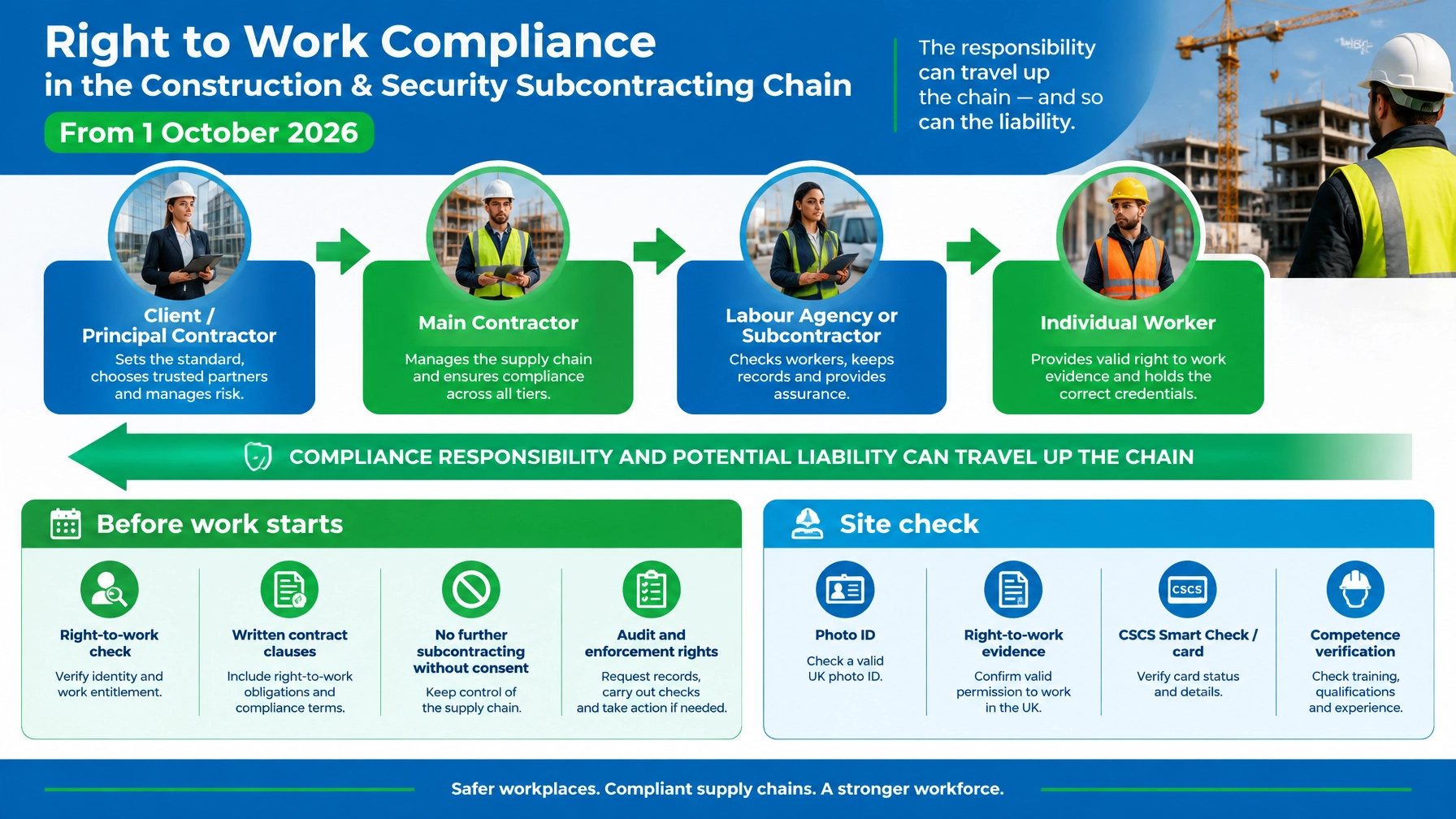
From 1 October 2026, right-to-work responsibilities extend beyond traditional employees.
The change follows the Border Security, Asylum and Immigration Act 2025. The definition of an “employer” now includes businesses engaging individual subcontractors in certain circumstances.
Businesses in a contractual chain may face liability for illegal working by subcontractors unless they have the required contractual protections and compliance systems in place.
This matters to:
- Construction companies and principal contractors
- Site managers and project managers
- Labour agencies and labour providers
- Security companies
- Facilities management businesses
- Self-employed tradespeople and individual subcontractors
- Businesses using workers through another supplier
The rules apply to relevant contractual arrangements entered into on or after 1 October 2026.
This article explains what has changed, what contracts should include, which documents prove the right to work, and how construction sites can combine identity, right-to-work and competence checks.
Important: This is general compliance information, not legal advice. Businesses should obtain professional legal advice before changing contracts, subcontracting arrangements or employment procedures.
WHAT CHANGED ON 1 OCTOBER 2026?
Previously, right-to-work checks mainly focused on employees and workers engaged directly by a business.
The updated rules extend the regime to include:
- Workers employed under a contract of employment
- Workers engaged under a worker’s contract
- Individual subcontractors
- Certain individuals supplied through another employer or service provider
- Individuals provided through online matching services
Calling someone “self-employed” or a “contractor” does not automatically remove the requirement.
The actual working arrangement matters.
An individual subcontractor may be covered where:
- A business contracts with another organisation to provide work or services.
- That organisation engages an individual to carry out the work.
- The individual has not contracted directly with the final client for those services.
The updated Home Office right-to-work checklist now includes individual subcontractors within the arrangements requiring a prescribed check.
WHO MAY NOW BE LIABLE?
Liability can move through the contractual chain.
For example:
Client → Principal contractor → Labour agency → Subcontractor → Individual worker
If an individual working at the bottom of this chain does not have permission to work, businesses further up the chain may face risk if they cannot demonstrate that the required controls were in place.
This does not mean every business is automatically liable for every person in its supply chain.
However, a business may need to show that it:
- Used suitable written contractual terms
- Required the relevant checks to be completed
- Controlled further subcontracting
- Had audit and information rights
- Verified the identity of the person doing the work
- Took appropriate action when concerns were identified
The controls must be in place before the work or services begin.
The updated Home Office Code of Practice on preventing illegal working sets out the prescribed checks and requirements.
WHAT MUST A COMPLIANT CONTRACT INCLUDE?
A contract with a labour provider, agency or subcontractor should clearly allocate responsibility for right-to-work compliance.
It should require the supplier to:
- Complete a prescribed right-to-work check before a worker starts
- Check every person carrying out the work
- Keep secure records of each check
- Provide evidence when requested
- Repeat checks when permission to work is time-limited
- Confirm that the person checked is the person attending the site
- Follow the Home Office code of practice
- Apply equivalent requirements to any permitted further subcontractor
The contract should also prevent informal substitution.
A subcontractor should not be able to send another person to a site without prior approval and a new right-to-work check.
This is separate from competence checking. A worker may have permission to work but still lack the training or qualifications required for the role.
FIVE-STEP COMPLIANT CONTRACT CHECKLIST
1. PUT THE REQUIREMENTS IN WRITING
Include clear clauses requiring the supplier or subcontractor to carry out prescribed right-to-work checks before work starts.
Do not rely on a general statement such as “the supplier complies with UK law”.
State what the supplier must check, record and provide.
2. CONTROL FURTHER SUBCONTRACTING
Require prior written consent before the work is passed to another subcontractor.
The supplier must also flow the same right-to-work requirements into any approved subcontract.
This creates a clear compliance trail from the client to the individual worker.
3. INCLUDE AUDIT AND INFORMATION RIGHTS
The contract should allow the business to:
- Review right-to-work records
- Request confirmation before site access
- Check supplier procedures
- Audit selected files
- Ask for remedial action
- Investigate concerns
The right to audit is only useful if it is used when appropriate and recorded.
4. ADD ENFORCEMENT CONTROLS
The contract should explain what happens if a check is incomplete, a worker has no permission to work, or a supplier refuses to provide evidence.
Possible controls may include:
- Suspending site access
- Removing an individual from the assignment
- Requiring urgent corrective action
- Suspending the supplier
- Terminating the contract
Get legal advice before drafting specific termination or indemnity wording.
5. VERIFY IDENTITY AND SUBSTITUTES
Build a process to confirm that the person completing the work is the person whose right to work was checked.
Where substitution is permitted, check the substitute before they start.
Do not allow informal swaps, replacement workers or additional labour on site without approval and verification.
QUICK-REFERENCE GRID: RIGHT-TO-WORK DOCUMENTS
| Evidence | Typical route | Follow-up check? | Key action |
|---|---|---|---|
| British passport, current or expired, showing British citizenship | Manual document check | No, if checked correctly | Check the document, identity and retain a secure copy |
| Irish passport or Irish passport card, current or expired | Manual document check | No, if checked correctly | Check the document, identity and retain a secure copy |
| UK birth or adoption certificate plus official National Insurance evidence | Manual document check | Usually no | Check both documents and confirm they belong to the individual |
| Digital immigration status or eVisa | Home Office online check using a share code | Yes, if permission is time-limited | Use the official online service and save the profile page |
| Time-limited visa or passport endorsement | Manual check or applicable online route | Yes, before permission expires | Record the expiry date and diarise the follow-up check |
| Positive Verification Notice from the Home Office Employer Checking Service | Employer Checking Service route | Usually time-limited | Retain the notice and follow its expiry period |
| British or Irish passport checked through an approved digital provider | Right-to-work digital verification service provider | Normally no for eligible continuous status | Use a registered provider and retain the output |
A share code is generally used for people with digital immigration status. A standard British or Irish passport holder normally proves their right to work through the passport route instead.
Employers must not demand one particular checking method from everyone or make additional document demands because of someone’s nationality, race or ethnic background.
Read the official GOV.UK guide to proving the right to work before deciding which route applies.
HOW TO CREATE A STATUTORY EXCUSE
A statutory excuse is the legal protection available where the prescribed right-to-work process has been followed correctly.
The basic process is:
- Obtain acceptable documents or online information.
- Check that the evidence is genuine and belongs to the person presenting it.
- Confirm that the person is permitted to do the specific work.
- Copy or download the evidence in a secure, unalterable format.
- Record the date on which the check was completed.
- Retain the evidence for the required period.
For manual checks, the person should be present in person or through a live video link while the employer has the original documents as required.
For online checks, the employer must use the official service, check the person’s photograph and review any work restrictions.
Records should be securely retained for the period of the engagement and for two years afterwards, then securely destroyed.
For subcontractors, the main contractor should also retain evidence of the contractual controls and any audits or confirmations completed.
CONSTRUCTION SITES: CHECK RIGHT TO WORK AND COMPETENCE TOGETHER
Right-to-work evidence does not prove construction competence.
A construction site should use separate but connected checks for:
- Identity
- Right to work
- CSCS or relevant card status
- Training and qualifications
- Role suitability
- Site induction
CSCS Smart Check can verify whether a card is genuine, current and linked to the appropriate training and qualifications.
A visual card check alone may not identify a fake, revoked or fraudulently obtained card.
A practical site process could be:
- Confirm the worker’s identity.
- Confirm the right-to-work check has been completed.
- Use CSCS Smart Check where a CSCS-logo card is presented.
- Match the cardholder’s photograph to the person attending.
- Check that the card and qualifications match the role.
- Complete the site induction and record access.

Workers may need a valid CSCS card, recognised health and safety training and role-specific evidence before they can access a site.
Zems Academy provides practical accredited training for people preparing for construction work, including routes linked to CSCS requirements.
WHAT SHOULD A SUBCONTRACTOR HAVE READY?
An individual subcontractor should be prepared to provide:
- A suitable right-to-work document or share code
- Permission details and expiry dates, where relevant
- Confirmation of their legal name
- Evidence of any change of name
- Their CSCS card or relevant industry card
- Certificates for role-specific training
- Contact details for their business or labour provider
- Details of any approved substitute
- Confirmation that they have completed site onboarding
Do not send screenshots where the prescribed process requires an original document or official online check.
Ask the main contractor which evidence is required before attending site.

SECURITY BUSINESSES MUST REVIEW THEIR SUPPLY CHAINS TOO
Security companies often use a mixture of employees, self-employed workers, agencies and subcontractors.
The new rules make it important to map every route through which a worker reaches a client site.
This is particularly relevant for:
- Door supervisors
- Security officers
- CCTV operators
- Event security teams
- Mobile response workers
- Concierge and front-of-house security
- Temporary event staff
A security business should combine right-to-work compliance with checks for required security qualifications and licensing.
Zems Academy delivers security training in Birmingham for people preparing to enter or progress within the security sector.
Book the correct training route, complete the required checks and keep evidence ready before deployment.

AVOID DISCRIMINATION WHEN CHECKING
Right-to-work checks must be consistent.
Do not:
- Ask only non-British workers for additional documents
- Reject someone because they use an online check
- Assume that an accent or nationality indicates immigration status
- Apply different checking rules to similar workers
- Refuse a valid prescribed method without a proper reason
Use the same procedure for comparable roles.
Train site managers, recruiters and subcontractor administrators so the process is applied consistently.
The Home Office has also published a separate code of practice covering the prevention of unlawful discrimination while preventing illegal working.
WHAT BUSINESSES SHOULD DO THIS WEEK
Construction and security businesses should now:
- Map every worker and subcontractor route
- Identify arrangements entered into on or after 1 October 2026
- Update supplier and subcontractor contracts
- Add audit and further-subcontracting controls
- Create a standard evidence request
- Introduce substitute-worker approval
- Train managers and administrators
- Connect right-to-work checks with site access checks
- Use CSCS Smart Check for relevant construction cards
- Keep a secure audit record
Do not wait until an enforcement visit or failed site audit.
Update the contract, check the worker and record the evidence before work starts.
For training and workforce development support in Birmingham and the West Midlands, contact Zems Academy.