CSCS Test Tips: How to Pass the CITB HS&E Test First Time With These 7 Insider Hacks

If you want a green CSCS Labourer Card, you usually need to pass the relevant CITB Health, Safety and Environment (HS&E) test.
The test checks that you understand the basic safety knowledge required to work responsibly on a construction site.
It is not a test you should leave until the last minute.
Use the right revision materials, practise the question format and focus on safe working decisions. These CSCS test tips will help you prepare for the CITB HS&E core test and improve your chance of passing first time.
Important: CITB confirms that the Operatives HS&E test contains 50 questions, lasts 45 minutes and has a 90% pass mark. You need at least 45 correct answers out of 50 to pass.

WHAT IS THE CITB HS&E TEST?
The CITB Health, Safety and Environment test is used to assess your understanding of safe working practices in construction.
It is an important part of the process for many CSCS cards, including the Labourer Card.
There are three main test types:
- Operatives
- Specialists
- Managers and Professionals
The correct test depends on your occupation, qualifications and the type of CSCS card you are applying for.
Use the official CSCS Card Finder if you are unsure which test you need.
For the standard Operatives test:
- You answer 50 questions.
- You have 45 minutes.
- You need 45 correct answers to pass.
- The pass mark is 90%.
- The test is completed on a computer or touch-screen system.
- Questions cover health, safety and environmental responsibilities.
The official CITB Operatives test page confirms the current test structure and pass mark.
WHAT TOPICS ARE IN THE CSCS CARD TEST?
The Operatives test covers five broad knowledge areas:
- The working environment
- Occupational health
- Safety
- High-risk activities
- The environment
You should expect questions about:
- Legal responsibilities
- Site rules
- Hazard identification
- Reporting unsafe conditions
- Personal protective equipment (PPE)
- Manual handling
- Working at height
- Fire safety
- Emergency procedures
- Tools and equipment
- Electricity
- Excavations
- Confined spaces
- Lifting operations
- Hazardous substances
- Dust, noise and vibration
- Asbestos awareness
- Waste and environmental controls
The test can also include behavioural case studies based on realistic construction situations.
The correct answer is normally the one that shows safe, responsible and proactive behaviour.
7 CSCS TEST TIPS TO HELP YOU PASS FIRST TIME
1. USE THE OFFICIAL CITB REVISION MATERIALS
Do not rely only on random online questions.
Start with the official CITB revision materials. The official GT100 publication covers the content for the Operatives test in a question-and-answer format.
CITB also provides a revision app with test simulations and topic practice.
Use these materials to:
- Learn the wording used in the test.
- Identify topics you do not understand.
- Practise answering questions against the clock.
- Review incorrect answers.
- Build confidence before test day.
The official CITB HS&E revision materials should be your main source.
Third-party mock tests can help with timing and technique, but always check important information against CITB guidance.
2. UNDERSTAND THE BEHAVIOURAL CASE STUDIES
Many candidates focus only on rules and definitions.
That is a mistake.
The Operatives test includes behavioural questions based on realistic site situations. These questions test how you would respond when something is unsafe.
You may need to choose what a worker should do when:
- A hazard has not been controlled.
- Someone is not wearing the correct PPE.
- A colleague is working unsafely.
- A piece of equipment appears damaged.
- A spill has been left unattended.
- A task is different from the agreed method.
- A worker is being pressured to continue.
Use this decision rule:
Stop, report, follow the procedure and protect people before continuing the task.
Avoid answers that involve:
- Ignoring the hazard.
- Taking a shortcut.
- Assuming somebody else will report it.
- Continuing because the job is urgent.
- Removing PPE because it is uncomfortable.
- Using damaged equipment.
- Working outside your training.
Safe behaviour is more important than speed.
3. PRACTISE THE TOUCH-SCREEN FORMAT
The CSCS card test is not completed on paper.
You answer questions using a computer or touch-screen system. If you have not used this format before, practise it before test day.
Use the CITB HS&E demo test to familiarise yourself with the screen and question styles.
Practise how to:
- Select an answer.
- Move to the next question.
- Read instructions carefully.
- Return to a previous question.
- Review your answers.
- Handle questions that ask you to select more than one answer.
Do not rush simply because you are using a screen.
Read every question fully before selecting an answer.
Pay attention to words such as:
- First
- Most
- Best
- Safest
- Before
- Immediately
These words can change the correct answer.
4. FOCUS ON THE HIGHEST-VALUE KNOWLEDGE AREAS
You need to understand the whole syllabus, but some subjects appear repeatedly in basic construction safety questions.
Give extra revision time to:
- PPE
- Manual handling
- Working at height
- Fire safety
- Hazard identification
- Risk controls
- Occupational health
- COSHH
- Asbestos
- Site responsibilities
- Emergency reporting
- Tools and equipment
Create a short revision list for each topic.
For example:
Working at height
Remember to consider:
- The risk of falling.
- Suitable access equipment.
- Edge protection.
- Fragile surfaces.
- Falling objects.
- Inspection requirements.
- The hierarchy of control.
Manual handling
Remember to consider:
- The weight and shape of the load.
- The route.
- The distance.
- Your own ability.
- Mechanical aids.
- Getting help when needed.
- Safe lifting technique.
Fire safety
Remember to consider:
- Raising the alarm.
- Following the site emergency plan.
- Using the correct escape route.
- Not blocking fire exits.
- Only using an extinguisher if trained and safe to do so.
- Reporting fire risks immediately.
5. LEARN THE KEY HEALTH AND SAFETY REGULATIONS
You do not need to become a legal expert to pass the Operatives test.
However, you should understand the purpose of important health and safety laws and regulations.
Focus on these three areas:
HASAWA
The Health and Safety at Work etc. Act 1974 sets out general duties for employers and employees.
Employers must provide, so far as reasonably practicable:
- Safe systems of work.
- Information and instruction.
- Training.
- Supervision.
- Safe equipment.
- A safe working environment.
Workers must also take reasonable care of themselves and others.
RIDDOR
RIDDOR is the Reporting of Injuries, Diseases and Dangerous Occurrences Regulations.
It covers certain serious work-related injuries, illnesses and dangerous occurrences that must be reported to the relevant enforcing authority.
If a question asks what you should do after a serious incident, choose the answer that involves following the site reporting procedure and informing the responsible person.
COSHH
COSHH means the Control of Substances Hazardous to Health Regulations.
It applies to substances such as:
- Chemicals.
- Solvents.
- Cement products.
- Dust.
- Fumes.
- Cleaning products.
- Vapours.
Follow the control measures provided. Check labels and safety information. Use the required PPE and report problems.
Do not use an unfamiliar substance without suitable information and instruction.
6. TAKE FULL PRACTICE TESTS UNDER TIMED CONDITIONS
Knowing the information is not enough.
You also need to practise completing 50 questions in 45 minutes.
That gives you approximately 54 seconds per question.
Take full mock tests under realistic conditions:
- Sit at a desk.
- Remove distractions.
- Set a 45-minute timer.
- Answer all 50 questions.
- Avoid checking your notes.
- Record your score.
- Review every incorrect answer.
Aim to score 45 out of 50 or higher consistently before your real test.
A single high score may be good luck. Repeated high scores show that you are ready.
Use this simple progress table:
| Practice test | Score | Action |
|---|---|---|
| Test 1 | Below 40/50 | Review the full syllabus |
| Test 2 | 40–44/50 | Focus on weak topics |
| Test 3 | 45/50 or higher | Repeat under timed conditions |
| Test 4 | 45/50 or higher | Prepare for test day |
If you repeatedly score below 45, continue revising before booking or sitting the test.
7. ARRIVE PREPARED WITH THE CORRECT ID
Good revision will not help if you cannot take the test.
Before leaving home, check your booking details and ID requirements.
Make sure:
- Your name matches the booking.
- Your identification is valid.
- You know the test centre location.
- You know how to get there.
- You allow time for delays.
- You arrive early.
- You follow the test centre instructions.
CITB advises candidates to check the arrangements for their test carefully. If you need reasonable adjustments, review the CITB support options before the test date.
Take your ID with you. Do not assume that a photograph or an expired document will be accepted.
QUICK-REFERENCE GRID
| Topic | What to remember |
|---|---|
| Test format | 50 questions in 45 minutes |
| Pass mark | 45 out of 50 correct |
| PPE | Wear the required equipment and report defects |
| Hazards | Control, avoid or report them before continuing |
| Manual handling | Assess the load and use help or mechanical aids |
| Working at height | Use suitable equipment and prevent falls |
| Fire safety | Raise the alarm and follow the emergency procedure |
| COSHH | Check the substance information and use controls |
| RIDDOR | Serious incidents may require formal reporting |
| Behavioural questions | Choose the safest responsible action |
| Test day | Bring valid ID and arrive early |
QUICK CSCS TEST QUIZ
Test yourself before booking your test.
1. What is the current pass mark for the CITB Operatives HS&E test?
A. 35 out of 50
B. 40 out of 50
C. 45 out of 50
D. 50 out of 50
Answer: C : 45 out of 50.
2. What should you do if you find damaged site equipment?
A. Use it carefully
B. Hide it so nobody uses it
C. Repair it without permission
D. Stop using it and report it
Answer: D : stop using it and report it.
3. What does COSHH relate to?
A. Construction site vehicles
B. Hazardous substances
C. Fire alarm testing
D. Working hours
Answer: B : hazardous substances.
4. What is usually the best response to an unsafe instruction?
A. Continue because the job is urgent
B. Ask another worker to do it
C. Stop and speak to the responsible person
D. Ignore the instruction
Answer: C : stop and speak to the responsible person.
PREPARE FOR YOUR CSCS CARD TEST WITH ZEMS ACADEMY
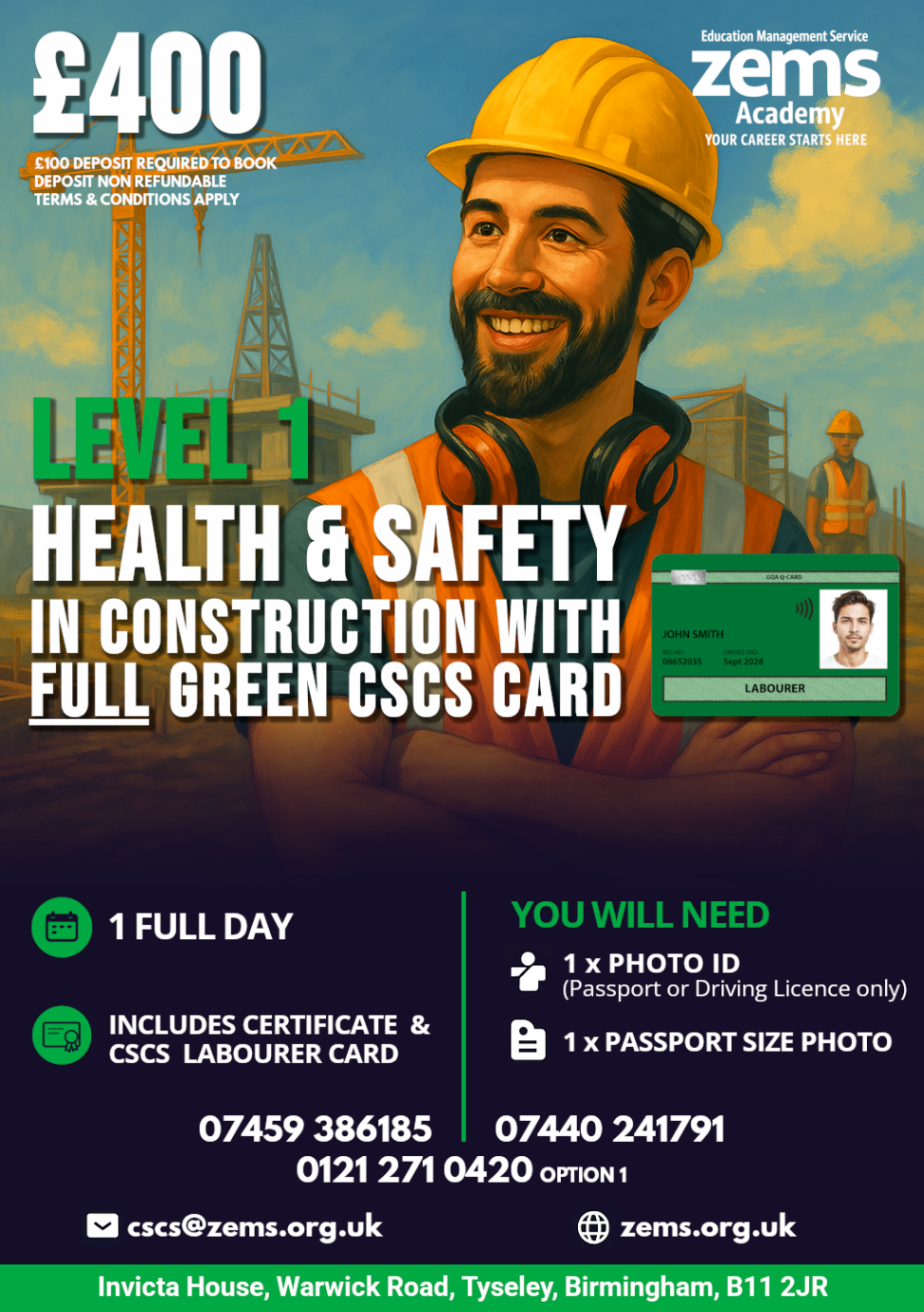
Zems Academy’s Level 1 Health & Safety in Construction package includes CSCS test preparation.
The training supports learners who want to:
- Understand basic construction health and safety.
- Prepare for the CITB HS&E test.
- Build confidence before entering a site.
- Work towards a green CSCS Labourer Card.
- Improve their employment options in construction.

The package includes recognised construction health and safety training. Course details, dates, fees and card arrangements may depend on your circumstances, so confirm the current information with Zems Academy before booking.

READY TO START?
Do not leave your CSCS card test preparation until the day before the exam.
Use the official CITB materials. Complete timed practice tests. Revise the key safety topics. Arrive with the correct ID.
For Level 1 Health & Safety in Construction training and CSCS test preparation, visit Zems Academy or contact the Academy at cscs@zems.org.uk.
Book your training. Prepare for your test. Build your construction career.